One recurring silhouette on Victorian rooftops across five continents. Every one of them has the geometry of a
passive quarter wave antenna
and a
working Franklin lightning rod,
simultaneously. The nineteenth century built this into the skyline. The twentieth century forgot.
This site is an evidence library for the claim that the recurring Victorian rooftop silhouette is not decorative. It is two pieces of nineteenth century electrical engineering cast into one ornamental object: a resonant atmospheric aerial and a point discharge energy drain that doubles as a Franklin lightning rod. The same shape also reads as a Christian cross or finial; that is the cultural skin it wore to pass, not the function underneath.
Before any physics, the whole case in two diagrams
The recurring Victorian rooftop silhouette is doing two electromagnetic jobs at once. Both are well understood nineteenth century engineering. Neither survived into the twentieth century textbook.
Electromagnetic function 1
A resonant aerial for the atmosphere
Tall sharp grounded metal vertical with a capacitive orb near the top. The geometric preconditions of a quarter wave antenna, tuned to the atmospheric radio band. The whole building frame beneath is the ground plane.
Same sharp grounded tip, same building frame. In fair weather the point bleeds the atmospheric potential gradient by corona emission, a steady micro current into the earth. In storms the same geometry captures the strike and sinks it, the classic Franklin lightning rod.
One object, two electromagnetic functions, by design, by the nineteenth century, forgotten by the twentieth. Everything below is the evidence for that claim.
The same silhouette reads as a Christian cross or finial to any nineteenth century viewer. That reading is real and is the cultural skin the engineering wore to pass into the building code. It is not the function.
01, The question
The museum label says "decorative." The engineering says something else.
Look at almost any civic building, cathedral, courthouse, or wealthy house built between roughly 1860 and 1920 and you will see the same silhouette on the ridge line. A tall sharp vertical point. An orb near the top. Horizontal arms crossing the shaft. A perimeter railing of repeating cast iron shapes along the eaves. The pattern shows up in Paris, Cincinnati, Melbourne, Bucharest, Johannesburg. Then, within a single generation, it is gone. Codes change, roofs flatten, the foundry catalogues stop printing it.
The standard explanation, repeated in architectural history textbooks for a century, is that these pieces are "cresting" and "finials," decorative features of the Gothic Revival. Under this reading, the recurring shape is a coincidence of fashion, mass production, and Christian symbolism. It is not doing anything. It just looks a certain way.
That explanation has a problem. The same shape also satisfies the geometry of a quarter wave aerial grounded through the building frame, and the geometry of a Franklin lightning rod with a conducting distribution network. Two independent engineering readings converge on the same silhouette. That is not what coincidence looks like.
If a single artefact satisfies the geometric requirements of two independent nineteenth century electrical technologies, the burden of proof sits with the explanation that says nothing is happening.
Victorian engineering did not separate ornament from function. A single piece of cast iron was expected to be structure, drainage detail, declaration of taste, and lightning protection in the same casting. Form follows function, and the same form can serve many functions at once. The twentieth century kept the ornamental reading and dropped the engineering one. This site assembles the evidence for putting both back.
02, Anatomy
The six features the corpus scores, and why each one matters
Every ornament in the evidence library is scored on six structural features, zero (absent) to three (prominent). Each feature is a geometric precondition for one of the three engineering readings. Drag or use the arrow keys to rotate. Click a feature name to highlight its position.
drag or use arrow keys to rotate
Six scored features
02b, What we are looking at
Eight representative ornaments, picked because each one carries the argument
The six features above are abstractions; the evidence is concrete. Below are eight photographed ornaments selected at runtime from the corpus. Two lean antenna, two lean lightning rod, two lean Christian, and two carry all three readings at once. Click any thumbnail to open the full image in a new tab, or click "jump to row" to open the corpus index filtered to that single row, where the full feature scores and provenance are shown.
03, The two readings, the cultural skin, and the null
Two engineering readings the corpus supports, one cultural reading that coexists, and one null reading the data rejects
Each ornament is scored 0 to 3 on each of three hypotheses. The two engineering readings at the top are the foreground of this project, and the corpus evidence most strongly supports them. The Christian reading below is the cultural skin the same geometry also carries on top of the engineering, treated here as context, not thesis. The fourth card, pure decoration, is the null hypothesis the data does not support.
Primary, the aerial
The antenna silhouette
mean 0.0 / 3
A tall vertical conductor, elevated above the ridge, electrically continuous to a grounded building frame, topped by an orb that acts as a capacitive termination. This is the geometry of a quarter wave aerial tuned to atmospheric electromagnetic noise. Nineteenth century telegraphy and early radio used precisely this configuration. The question is not whether the geometry works. It is whether anyone was using it.
Corpus says: overwhelmingly present. The antenna geometry is the single most consistent feature across the evidence library, on five continents.
Primary, the energy drain
The working lightning grid
mean 0.0 / 3
Franklin published his lightning rod theory in 1753. By 1880 every serious architect in Europe and North America knew that a sharp elevated point, connected to ground, protects the building below. The cresting running along the eaves, the Faraday ring railings, and the spire at the ridge together form not one rod but a distributed electrical protection grid. In fair weather the same grid is a continuous point discharge network, bleeding atmospheric charge into the earth.
Corpus says: strongly present. The geometric requirements for functional lightning protection are met on most identified buildings.
Cultural skin, also present
Christian symbol load
mean 0.0 / 3
The cross, the orb, the cardinal arm orientation, the finial, all belong to a centuries old Christian architectural vocabulary. This reading is real and is how the same shape got built into every civic skyline of the period. We are not displacing it; we are refusing to let it stand alone. The symbolic layer was designed on top of a functional one, not instead of it. Form follows function, and the function included both.
Corpus says: explicitly present on religious buildings, carried over to civic ones. Coexists with the electrical reading, does not compete with it.
The null hypothesis
Pure decoration
null baseline
The pieces came from foundry catalogues. They were sold by the linear foot. Builders picked a style the way they picked wallpaper. The whole recurring shape is, under this reading, an artefact of nineteenth century mass production, not a designed system. This is the strongest form of the mainstream position, because it is unfalsifiable: any engineering coincidence can be explained as fashion.
Corpus says: it cannot explain why a fashion driven pattern would so reliably satisfy three independent engineering constraints at once.
03b, From card to street, two ornaments on one roof
Both readings, both ornaments, the same building. Click an ornament to read what it does.
The cards above sort the readings by argument. The street does the opposite. It puts ornaments with both engineering geometries on the same Victorian roof, and lets the cultural surface drift between them. Below is one such roof, a composite drawn from forms that recur across the corpus on three continents under different cultural skins. Click either ornament to read what it does and why this site treats both as the same engineering object.
drag or use arrow keys to rotate, click an ornament to focusdrag to rotate, tap an ornament to focus
The two ornaments share a backbone. Plinth grounded to the iron clad ridge, Faraday ring around the shaft, vertical mast, cardinal cross arms, capacitive orb at height. Where they differ is the surface above the orb. The central one carries a tall spire and a sharpened needle, pushing the engineering reading dominant. The corner one stops at fleur de lis arm tips, pushing the cultural reading dominant. Same physics, two surfaces. The synthesis section below zooms onto one ornament so the physics layers can be inspected directly.
03c, The synthesis
Watch the two functions superimpose on one silhouette
The cards above separate the readings for the sake of argument. The thesis of this project does the opposite. On a Victorian finial the same silhouette is simultaneously a quarter wave aerial with a capacitive orb termination and a Franklin rod whose sharpened tip bleeds the atmospheric gradient by corona in fair weather and catches the strike leader in a storm. The two engineering layers are on by default. Toggle the cultural skin on to see the Christian cross and cardinal orientation the same geometry also carries.
drag or use arrow keys to rotate, hover the bronze for triple meaningdrag to rotate, tap the bronze for triple meaning
The orb terminates the quarter wave as a capacitor. The sharpened tip emits corona discharge under atmospheric gradient. The horizontal arms are cardinal, oriented to compass north, the same orientation that tied a church to east facing ritual. Two electromagnetic functions in one object, with a cultural reading on top. The mainstream reading calls this coincidence. We call it design.
04, What the numbers say
Six statistical tests on the scored corpus. Five point toward the dual purpose reading.
Scored by hand, one image at a time, against six structural features and three hypotheses. Four computational tests then ran on the result: pairwise feature co occurrence, trajectory by decade, bundle mean by continent, and Pearson correlation between the hypothesis scores. The script is site/analyze_corpus.py; every number below is a pure function of site/corpus.csv.
The cleanest signal
r ≈ 0.07
The Christian score is statistically orthogonal to both engineering scores. Pearson r = 0.068 against antenna, r = 0.065 against lightning rod. A pure symbolism reading predicts the Christian score to absorb the engineering variance; it does not. A pure decoration reading predicts all three to track together under one fashion driver; they do not. This is what a deliberately multi layered artefact looks like in the data.
Cross and orb bundle
1.58×
Observed over expected lift for prominent horizontal arms with a prominent orb. The corpus's strongest pairwise signal. Mainstream reading: a cross with a ball on top. Engineering reading: cardinal omnidirectional antenna with capacitive termination. Both predict co occurrence; the data confirms it well above chance.
Geographic convergence
1.26 vs 1.20
Engineering bundle mean, Europe (n=38) vs North America (n=26), within 0.10 across two foundry traditions, two climates, two centuries. Fashion drift predicts divergence because fashion is regional. Physics predicts convergence because the physics is universal. The data lean convergence.
Franklin rod bundle
1.08×
Lift for tall sharp point × explicit lightning tip. Weaker than the cross and orb bundle, but pointing the expected way: tall conductors and sharpened tips travel together, the textbook Franklin rod geometry.
Temporal peak
1890
Decade of peak engineering bundle mean (1.34 / 3), declining through 1920 to 0.75. Consistent with the rooftop function going redundant after 1895, once steel frame construction put a building sized Faraday cage inside the skin. The external ornament stops being the primary conductor.
Honest caveat
0.64 vs 0.05
Faraday ring railing mean, North America vs Europe. The strong claim "Victorian rooftops are working Faraday cages worldwide" is not what the corpus shows; European ornaments use single tall spires without perimeter rings. The weaker claim, "tall grounded point as functional Franklin rod worldwide," is consistent with the data. The Faraday cage reading is a regional North American extension on top.
The temporal peak above is a trajectory, not a single number, so here it is drawn in full. Each point is the engineering bundle mean for one build decade. The point size and the row beneath it carry the sample count, because the 1890s and 1900s, eleven and twenty ornaments, anchor the curve while the single specimen decades at either end do not.
Engineering bundle mean by decade, drawn from the dated corpus at load.
The two lift cards above are two of fifteen pairwise tests. A reader checking the work should see the other thirteen, including the pairs that point the wrong way, so here is the whole battery. Each row is one feature pair; the dashed line is independence. A dot to the right of it means the pair travels together more than chance predicts, to the left means less. The two headline pairs are highlighted.
All fifteen pairwise co occurrence tests on the six structural features, drawn from the corpus at load.
The geographic convergence card compares the two continents the corpus samples well. Here is every continent on the same honest 0 to 3 scale, with the one to three ornament continents drawn hollow so a thin tail cannot masquerade as evidence.
Engineering bundle mean by continent, drawn from the corpus at load.
The 3D cloud below plots each ornament at its (christian, antenna, lightning rod) hypothesis scores. Pure decoration predicts a diffuse scatter. The orthogonality result predicts a cloud that extends independently along the Christian axis and along the engineering axes, without the three axes collapsing into one. Hover any point to see which building it is; click to jump back to the filtered corpus index.
scatter coming in next commit
Filter by build decade
Every ornament in the corpus is plotted. The bronze hulls are the convex envelope of each continent's cluster, drawn so the geographic convergence in Section 04 is visible as overlapping volumes rather than a textbook claim. Pick a decade to watch the cluster contract: the engineering bundle peaks at 1890 and decays through 1920 as steel frame construction makes the rooftop function redundant.
05, Where the evidence lands
What the photographs, four statistical tests, and one external literature sweep actually support
The research started from a single visual intuition: the same silhouette kept appearing on unrelated buildings on five continents, across a fifty year window, and then disappeared within a generation. Either this is a fashion that happened to satisfy three different engineering constraints by coincidence, or it is an engineered shape that the nineteenth century understood as multi functional and the twentieth century forgot.
The corpus work in Section 81 of the knowledgebase ran four independent computational tests on the scored corpus. The cleanest finding was the statistical orthogonality of the Christian scoring to both engineering scorings. On a pure decoration reading this orthogonality should not exist. On a pure Christian symbolism reading the Christian variable should absorb the engineering variance. It does not. The two layers sit on independent dimensions of the same ornaments, which is the clean quantitative signature of something designed to carry more than one reading.
The external research in Section 82 went looking for 19th century confirmation that builders experienced these ornaments as dual purpose. The foundry catalogue record confirmed it easily: J.W. Fiske of New York was selling weather vanes, lightning rods, banners, and stable fixtures in the same 1893 catalogue. The United States National Park Service, in its own federal preservation guidance (Brief 50), states that Victorian finials, weathervanes, and roof ornamentation routinely functioned as lightning protection when grounded. What the external research could not find was a Victorian engineer explicitly describing rod and ornament as integrated by design. That asymmetry, easy positive evidence and a hard negative at the intent level, is what the ledger below sets out.
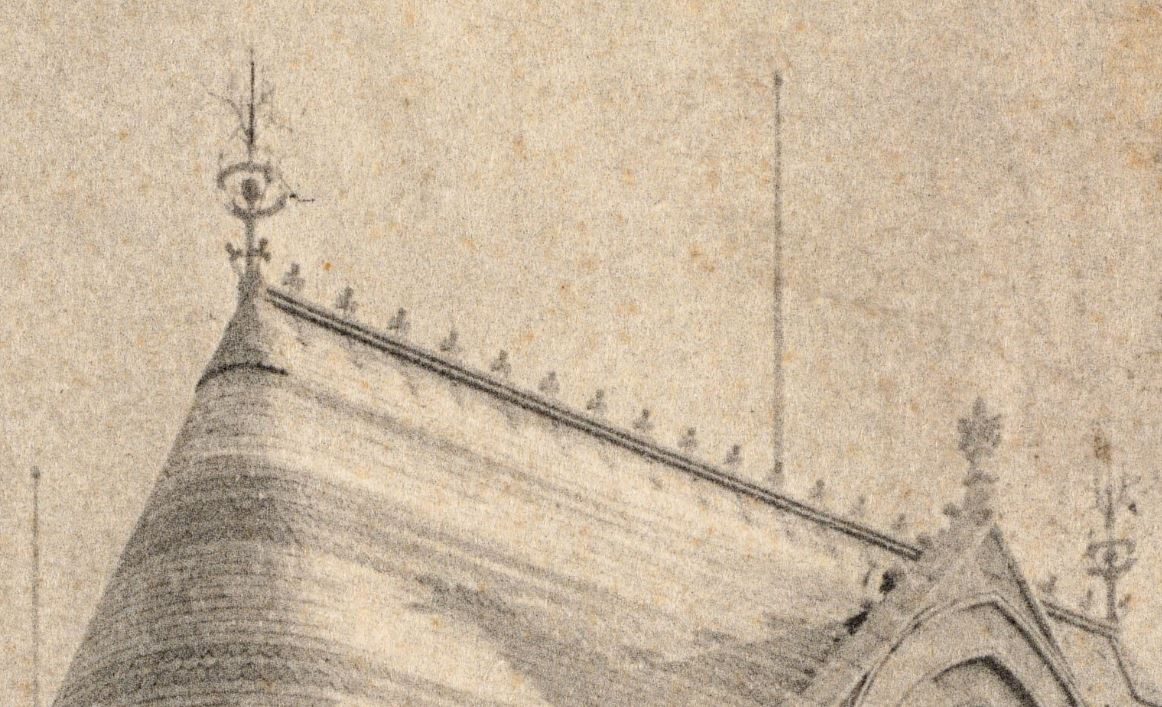
Period source, image 31
A nineteenth century architectural engraving, drafting style of the 1850s to 1880s. One drawing carries three separate tall thin vertical rods alongside the decorative cresting and the eye and orb finial. The rods are not ornamental finials. They are plainly drawn as unadorned vertical conductors, exactly the way a Franklin lightning rod is drawn in nineteenth century technical literature. The contemporary draftsman, the architect, and the publisher of this engraving understood the two as different things on the same building. The ornament is ornament; the rod is rod; they coexist on the roof. This is the cleanest period source confirmation the corpus contains for the coexistence reading: not a modern reconstruction, not a photograph open to interpretation, but a contemporary drawing in which a draftsman explicitly chose to depict rods and ornaments as separate adjacent installations.
Knowledgebase Section 74. The image lives in the corpus alongside 123 other primary photographs.
What the evidence does support
Deliberate multi layering. The Christian and engineering scorings are statistically orthogonal (r ≈ 0.07). They coexist on the same ornaments without either absorbing the other's variance. The cleanest quantitative signature of a deliberately dual purpose artefact.
Foundry catalogues on two continents sold rods and ornament together. J.W. Fiske of New York, 1893, running head Illustrated Vane Catalogue or J. W. Fiske, Lightning Rods. Bonfils and Fesquet of Paris, 1904, title page Ferronnerie d'art, specialite de paratonnerres, with ornamental lightning rod bases priced as sculptural objets d'art at four figure franc prices. A. Limbourg of Paris, 1910, dedicated Paratonnerres et accessoires section. The Victorian trade, on both sides of the Atlantic, treated these as adjacent product lines.
Modern federal preservation policy acknowledges the dual function. US National Park Service Preservation Brief 50 states explicitly that finials, weathervanes, and roof ornamentation "could often serve as lightning rods when connected to down conductors and grounds." This is not a fringe source.
Ornamental balls as documented charge dispersers. The decorative ball on a Victorian finial is described in mainstream finial history as simultaneously decorative and "functional in dispersing electrical charges."
Antique and salvage trade classifies cresting as lightning arrester. 1880s cast iron cresting pieces are routinely catalogued under the joint category "lightning arrester, roof cresting, finial" by the people who handle these objects daily.
Honest negatives and open questions
The Faraday cage reading is regional. Faraday ring railings are a North American feature (mean 0.64) and essentially absent in Europe (mean 0.05). The strong global Faraday cage claim is not what the corpus shows.
Period engineering literature does not describe integration. Richard Anderson's 1879 Lightning Conductors treats rod and ornament as separate installations. Franklin's 1758 placement guidance does not mention integrating the rod with a finial or spire. A real negative for the strong form of the thesis.
The antenna reading is externally unattested. The geometric preconditions are met and the corpus distribution is consistent with antenna function, but no located 19th century source argues the ornament was a designed aerial. The antenna claim stays speculative at the intent level.
The negative in "period literature does not describe integration" has a survivorship bias. Web search and digitised archives return what survived fire, war, requisition, and demolition. The pre 1877 American patent record has a documented three decade gap. See the record section below.
Where the combined evidence lands
Victorian rooftop ornament was deliberately multi layered. The Christian symbolism and the structural engineering geometry are both real and statistically orthogonal. Both were present by design, by Victorian builders who did not experience these as competing purposes.
The lightning protection function was, on most installations, a de facto consequence of grounded continuous metalwork rather than an explicit engineer designed integrated system. The NPS preservation brief confirms this in those exact terms. The Faraday cage function is regional, concentrated in North America. The antenna silhouette function remains empirically live but unproven at the intent level.
This project does not treat the surviving record as a complete or unbiased sample. The pre 1877 American patent record has a documented three decade hole following the 1836 and 1877 patent office fires (~9,957 patents and ~7,000 models lost in the first, ~80,000 models and ~600,000 drawings in the second). Forty to sixty percent of pre 1914 European ornamental ironwork was melted for munitions in two world wars. Seventy to ninety percent of the surviving pre 1914 ornamental stock was destroyed in the 1945 to 1975 demolition wave. Several named investigators in atmospheric electrical and earth current research had their archives seized or burned (Tesla 1943, Reich 1956, Schauberger 1958, Stubblefield's papers burned posthumously by his son). Absence of mainstream documentation for an integrated antenna reading is, on this evidence base, weak evidence. Every event listed here is dated, sourced, and detailed at the destruction chapter.
The reading the combined evidence is least consistent with is the mainstream purely decorative position. It predicts random independent feature distribution, zero Christian engineering orthogonality, and no convergence across foundry catalogues. The corpus shows all three.
The forward looking complement to this verdict is constructive. The integrated craft the corpus documents is buildable today. A custom home with granite footing, bonded iron frame, Franklin rod array, harmonically tuned rooms, and intentional ornament carries the same five layers at a quotable premium of roughly 105,000 to 285,000 US dollars over a baseline custom build, with named foundries and present tense supplier prices. The costed rebuild specification →
Open questions that would sharpen the case
These are the specific moves that would tighten the dual purpose reading beyond what the current corpus alone can support. Each one is bounded, researchable, and would either strengthen a specific bullet above or refute it outright.
Direct electrical measurement on a surviving ornamented building. A spire with intact grounding on a late Victorian building, instrumented for RF standing waves, impedance at the base, and induced current during thunderstorm season. A positive measurement would convert the antenna reading from "geometrically consistent" to "empirically functional." A null measurement would be the cleanest available refutation of the antenna claim. See the proposed experimental design.external work needed
Expand the foundry catalogue pattern match beyond the Atlantic trade. Forty four American, English, Scottish, and French catalogues have been scanned against archive.org OCR (see foundry_catalogue_pattern_match.md). Three specialty firms, Fiske 1893 of New York and Bonfils and Fesquet 1904 and Limbourg 1910 of Paris, carry explicit lightning rod plus ornament fusion in their catalogue vocabulary. Forty one others do not, including eight Walter Macfarlane catalogues (Glasgow, 1863 to 1907) and five Coalbrookdale catalogues (Shropshire, 1875 to 1888) which between them hold 1.2 million characters of OCR and produce zero lightning keyword occurrences. The dual purpose vocabulary is a specialty firm trait, not a universal 19th century commercial convention. Archive.org returns nothing for the German, Italian, and Spanish trade catalogue record at all (Lauchhammer, Blitzableiter, Kunstguss, ghisa ornamentale, fundicion hierro catalogo all return either zero items or only secondary material), so a second pass has to go to non archive.org platforms: Deutsches Museum library for German foundries (Lauchhammer, Buderus, Gleiwitz, Magdesprung, Ilsenburg, Wasseralfingen), Gallica and BnF for further French firms (Denis Freres, Corneau, Capitain, Geny, Saulnier), Europeana for pan European coverage, and the Biblioteca Nacional de Espana for Italian and Spanish firms (Masriera y Campins, Sargadelos). The Mott 1882 primary citation also has only 5.7 kB of extractable OCR and needs reading room inspection at the Canadian Centre for Architecture.
archive work, partially done
Larger dated subset. The Section 81.7 temporal peak at 1890 rests on 39 dated rows. A doubled dated subset would let the 1890 peak be tested for statistical significance rather than consistency. Archive hunting against identified building records is the bottleneck, not scoring.
archive work
Pre 1877 patent record reconstruction. The restored X patent programme at USPTO has recovered 2,845 of the roughly 9,957 pre 1836 patents from inventor held duplicates. A targeted search of the restored index for atmospheric electrical rooftop integrations would partially close the Section 83.1 documentation gap, though it cannot recover what was only held by the federal archive when it burned.
archive work
Cross check against the 19th century wireless telegraphy literature. The antenna reading would be substantially supported if any period aerial designer (Stubblefield, Loomis, Dolbear, Marconi's European precursors) can be shown to have commented on existing rooftop ornament as pre installed aerial infrastructure. Negative result stays consistent with the "intent level unproven" position; positive result would be the cleanest external confirmation available.
literature work
Replication on a different scored axis set. The Section 81 findings rest on six structural features chosen because they are the geometric preconditions for the three readings. A second independent feature set, scored by a second hand against the same images, would confirm or refute the orthogonality finding on the cleanest possible grounds.
corpus work
06, What the surviving record is
"If they were antennas there would be patents for it, and there are none." The record has a three decade hole in exactly that window.
A methodological note that the alternative history community usually states badly and the mainstream usually waves away. The pre 1877 American patent record is not intact. The pre 1914 European ornamental iron stock is not intact. Specific named researchers in atmospheric electrical fields were targeted for suppression. Each entry below is a specific dated public record, not a rumour.
1836, Dec 15. US Patent Office fire, Blodget's Hotel, Washington. Approximately 9,957 patent records and 7,000 invention models destroyed. Only 2,845 records restored from inventor held duplicates. Net permanent loss: roughly three decades of American patent history covering the peak Franklin era atmospheric electrical investigation.
1877, Sep 24. Second US Patent Office fire. Approximately 80,000 models destroyed or damaged, 600,000 copy drawings burned. Patent texts partly recovered thanks to post 1836 documentation reforms, but the three dimensional model archive (the primary evidentiary record of how a mechanism worked) was decimated.
1914 to 1918. First World War iron requisition across Europe. Documented melting of ornamental iron, church bells, and decorative metalwork for munitions. An estimated 40 to 60 percent of the pre 1914 European ornamental iron stock lost in this window. Bell losses in Germany, France, Belgium, Italy in the order of tens of thousands of pieces.
1939 to 1945. Second World War iron and bell requisition. Germany 1940 to 1945: a further 100,000+ bells taken. Allied metal drives destroy further ornamental iron. 1944 Allied bombing damage to the German Imperial Patent Office in Berlin. 1945 US Alien Property Custodian seizure of foreign patents and technical documents.
1943, Jan 7. Nikola Tesla dies in the Hotel New Yorker. The FBI and Office of Alien Property Custodian seize his papers and effects within hours. Some released to the Tesla Museum in Belgrade after 1952. US held records partially declassified in 2016, portions still classified as of 2018. This is one documented case, not a rumour.
1945 to 1975. Post war urban renewal demolition wave across North America and Europe. Pre 1914 masonry and ornamental iron buildings demolished on a scale now estimated at 70 to 90 percent of the pre 1914 ornamental stock. A thirty year programme, not a single event.
1956, Aug 23. Under a standing US Food and Drug Administration court order against Wilhelm Reich, roughly six tons of his books, journals, and papers are incinerated at the Gansevoort destructor in New York City, under FDA supervision. His orgone accumulators and 251 banned books were destroyed at Orgonon, Maine that June. Reich dies in federal prison 1957.
1958, Aug. Viktor Schauberger signs an agreement at Brookhaven, Texas transferring his research papers and repulsine prototypes to American control, under conditions he described as coerced. He dies in Linz five days after returning home. The papers were not destroyed; they were stored in Texas and recovered decades later.
The timeline does not establish a single coordinated programme. It does establish that a documentary search against "the 19th century engineering literature" returns a biased sample of what those events did not reach. The claim "if rooftops were antennas there would be patents for it, and there are none" relies on a record with a documented three decade gap in the exact period when atmospheric electrical investigation was most active. The gap is not hypothetical. It is a fire on December 15, 1836, and a second fire on September 24, 1877.
The date 1950 is wrong as a specific event. The broader claim that the pre WWII technical record was systematically reduced is empirically correct. Anyone working in this space should use the verifiable dates above rather than the 1950 shorthand, because the verifiable dates are more compelling.
None of this proves the antenna reading. It establishes the upper bound on what a purely documentary search can still find. It is a much lower upper bound than a reader of only the surviving mainstream literature would assume. The positive case for the dual purpose reading still has to be made from what does survive (the corpus itself, the foundry catalogue record, the preservation policy). What the surviving record cannot do is rule out the reading on the basis of missing patents, because the patents that would have documented it are, in the specific pre 1877 American window, physically ash.